Public Art Sculpture in SWFL
From Brett Harvey’s roving Bacchus busts to Ft. Myers’ century-old sentinel, Southwest Florida’s public sculptures shape– and are shaped by– the communities that claim them.
On a Friday afternoon in early 2025, Naples’ Fifth Avenue South buzzed with peak-season foot traffic. Past The French Brasserie Rustique’s (now Tulia Italian Steak) sun-drenched courtyard, a group of strangers clustered around the sidewalk. Here and there, a voice rose above the clatter of forks and hum of motors.
What’s this all about?
I thought I saw this over at Waterside Shops?
No, no, it was at the marina.
Who is it? Is there a plaque?
A slight parting between shoulders revealed the catalyst: Vinum Vitae, one of nine 550-pound busts of Bacchus—the Roman god of food, wine and fertility—crafted by local sculptor Brett Harvey and placed at different locations around town for four months to celebrate the 25th anniversary of the Naples Winter Wine Festival (NWWF). “It felt exciting. It was something no one had ever really done in Naples,” says Method & Concept owner Chad Jensen, who organized the project. “It was temporary, and there was something actionable about it. Even though they were all essentially the same, people would come and say, ‘I visited every one.’”
Farther north, Fort Myers leaders and residents were locked in debate on how to restore the city’s most notable piece of public art: The Spirit of Fort Myers (Rachel at the Well). The sculpture, a Grecian female figure pouring water from a jar, dates back to 1926, when developer James D. Newton commissioned sculptor Helmuth von Zengen to create a piece to adorn the entryway to the newly minted Edison Park neighborhood.
In the 100 years since, the community has adopted the stately figure as its own. For decades, students from Fort Myers High School snuck out to paint her in their school colors. She has been the inspiration for baby names and served as the backdrop for countless wedding photos. When Hurricane Ian’s powerful winds caught the sculpture’s bougainvillea-wrapped, iron-bar backing in 2022, the metal rods tore through the surrounding columns and split the figure in two. Over the years, the community had rallied around her, scrubbing away rust, filling cracks, putting her back together again. This time would be no different. By December, the sculpture had returned, her surround nearing full restoration.
Two sculptures, divided by a century, united by a common thread—public art’s ability to ignite something shared within us. Where Brett’s busts brought excitement, curiosity and discovery, The Spirit of Fort Myers’ stewardship shows how novelty can deepen into civic identity.
Public art takes shape alongside the community, reflecting shared ideals and aspirations, creating conversations and gathering points where people once passed through. It is also one of the most difficult things to do well—balancing artistic vision with patron expectations and public reception, with outcomes nearly impossible to predict. Once installed, it becomes easy to take for granted yet unthinkable to lose. “A successful piece of public art is something that operates on many different levels,” Brett says. “If it happens to be a portrait, it can be read as a portrait, a celebration of what that person has done. But I think it should also operate on a more universal level; it should be an emotional, thought-provoking endeavor.”
The nine editions of Vinum Vitae did just that. Placed at Maserati Naples, the bust channeled luxury and provenance. Positioned outside of Naples Children Foundation—the nonprofit.
behind NWWF—it served as a triumphant reminder of lives changed. Amid the NCH Baker Downtown’s Garden of Hope and Courage, where nurses and patients retreat for a peaceful respite, the bust offered a steadying presence.
Just as different settings changed the impact of Brett’s ephemeral installations, permanent public sculptures anchor us in a sense of place. We see this clearly in Ave Maria. A small Catholic university town, about 40 miles inland from Downtown Naples, Ave Maria orbits a town square, with a grand oratory at the center, where a towering sculptural relief—The Annunciation—sets the tone for an entire community.
Above the entryway to Ave Maria Catholic Church, the angel Gabriel kneels, his tranquil expression carved out of Carrara marble, sourced from the same quarry Michelangelo used. Gabriel’s left arm stretches out toward the Virgin Mary, who stands 30 feet tall and stares straight on. Her expression invokes the humility of the Annunciation, the moment when Mary is told she will give birth to God’s son, according to Christian belief. The relief conveys a sense of honor and assurance for a place shaped by faith. Hungarian-born sculptor Márton Váró—who completed the three-year project in 2011—designed the relief as a mirror image of Michelangelo’s famed Pietà, a marble sculpture depicting Mary mourning the death of Jesus, which commands attention at St. Peter’s Basilica in the Vatican. “I had the best time of my career carving that sculpture,” Márton says.
Ave Maria Catholic Church was conceived as the literal and spiritual center of Domino’s Pizza founder and leading Catholic philanthropist Thomas Monaghan’s master-planned community. The structure feels worlds apart from its neighboring towns. Though less than two decades old, it harkens to the chapels and parishes of the Old World, connecting the young neighborhood with the ancient roots of its defining faith.
Márton’s sculpture amplifies this intention, serving as a pilgrimage point for visitors and a daily touchstone for residents.
The 82-year-old sculptor has crafted public works across Central Europe and America. He never calls in supplemental carvers—every inch of Ave Maria’s monumental relief was carved by his hand, with a chisel and hammer, following the methods he learned from master carvers more than 60 years ago in a Hungarian cemetery.
Naples holds a special place for Márton. Since his introduction to the city around 2008, he’s planned four additional public works for the area and installed two: La Donna, an abstracted tower of cubes at the intersection of Highway 41 and Collier Boulevard, and Serenity, a Grecian figure sitting in repose at NCH’s Garden of Hope and Courage. The piece reflects Márton’s penchant for classicism, while channeling a powerful, knowing expression. “She was made to be positive for the nurses and the doctors and the families,” he says. “It is not so simple to put into words. If I were a writer, I would have written a poem, but I am a sculptor. I speak with my work.”
Having gained international recognition over the decades, Márton can now be choosy about his projects and only takes on public works when he can have full artistic freedom. But that is rarely how it works. Most of the time, commissions function like a dance, with the artist, patron and a rotating cast of institutional forces shaping the brief. In the case of Brett’s Vinum Vitae, NWWF first proposed a series of simple cubes inscribed with their 25th anniversary logo. Chad, a longtime collaborator with the festival through Thomas Riley Artisans’ Guild, proposed a depiction of Bacchus—a piece with broader impact, something to echo Naples’ namesake city and nod to the revelry of the festival. When NWWF agreed, he called Brett in to bring the concept to life.
In search of deeper resonance, Brett researched the Greek god who inspired the Roman Bacchus. “Dionysus deals with exploring the boundaries of what is healthy human behavior,” he says. “There was this idea that it’s a positive thing to be kind of wild and crazy, that it’s important to have those experiences to balance out the other parts of your life.” Brett sees those ideals reflected in Naples—the balance of work and celebration, the pleasures of life as both a source and result of success. He proposed a piece where the key subject was depicted as youthful, with taut musculature, wide eyes and an upturned gaze denoting a sense of curiosity and unburdened openness to new experiences. To his pleasant surprise, he received only one piece of critical feedback: He looks too young. Can we add a beard?
In the best cases, a public commission works this way, like a prompt, a starting point for artistic thought. Still, a public sculpture ultimately belongs to the community, its meaning shaped by the people who accept it, resist it or come to claim it as their own. When Helmuth created The Spirit of Fort Myers 100 years ago, he thought a well-placed tarp would shield him from public scrutiny before the project was unveiled. He miscalculated. Despite his discretion, neighboring ladies—led by the formidable Mina Edison—sneaked out under cover of night to see the work in progress. Mina, appalled at the figure’s exposed breasts, called the young developer to her home and grilled him until he suggested the sculptor might cover her in a gauzy wrap. “[Helmuth] just about tore his hair out,” James, the developer, later wrote. The addition was no simple task, but the artist complied, and Mina later helped to unveil the statue she once condemned, cementing its impact for years to come.
A century later, the particulars have changed, but the pattern is familiar. Public art still invites scrutiny, debate and, at times, discomfort, especially when it challenges expectations of propriety. Back in 2023, Chad placed Brett’s sculpture Tempo Temple Template—an exploration of division expressed through a male and female figure—at the entrance of the gallery’s former location at The Collective. “Within the first week, I got a letter asking me to remove the sculpture,” he says.
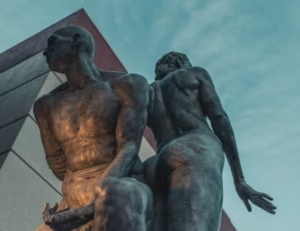
Like most of Brett’s work, the sculpture centered on the nude human form, pronounced musculature and emotional expressions first modeled in clay, then cast and finished in concrete. “Some people will go to Rome or Greece, and they’ll go see the David and all of these nude sculptures throughout Europe, and nobody’s coming back with the idea that those were inappropriate images. But for some reason, when they come back to the U.S., it’s almost like their lens changes. I’m really interested in that contextual shift,” Chad says.
Rather than succumbing to the pressure, Chad and his team held to their vision for a future where Southwest Florida’s public art scene continues to grow—in depth, in nuance, in respect for craft and artistry. He wrote back, situating the work within the longer tradition of classical sculpture and urging the critic to consider how context shapes perception. The sculpture remained in place until last year, when Method & Concept relocated to the Thomas Riley Artisans’ Guild campus in North Naples, bringing Tempo Temple Template along as a defining marker for the gallery. “Ultimately, they changed their minds,” Chad says of the exchange. “That was the moment. Sometimes you need to provoke a conversation, to open up a dialogue and, hopefully, to help people value the arts more in their own community.”